







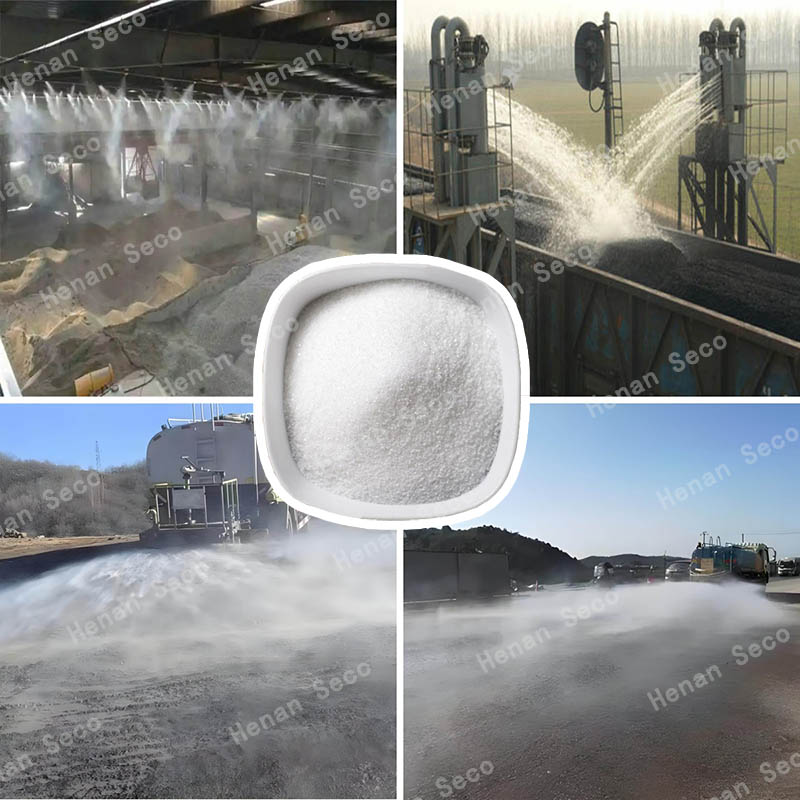
### Why Anionic Polyacrylamide (APAM) is an Extremely Effective Dust Suppressant
Anionic Polyacrylamide (APAM) has proven to be a highly effective dust suppressant due to its unique **long-chain molecular structure** and exceptional **hydration properties**. It achieves efficient dust control through the following core mechanisms:
#### 1. Strong Hygroscopicity and Water Retention
- **Hygroscopicity:** The molecular chains of APAM contain numerous amide groups (-CONH2) and carboxylate groups (-COONa, after hydrolysis). These groups are hydrophilic, meaning they have a strong affinity for water molecules and can actively absorb moisture from the air.
- **Water Retention:** After an APAM solution is sprayed onto dust or soil, it forms a viscous, gel-like film as the water begins to evaporate. This film effectively locks in moisture, significantly slowing down the evaporation rate and keeping the surface damp for an extended period. Damp dust particles are heavier and tend to stick together, making them resistant to wind erosion.
#### 2. Excellent Binding and Coagulation Action
- **Bridging Effect:** APAM is a linear polymer with very long chains. When dissolved in water and applied to dust, the negatively charged groups along the chain (carboxylate ions) adsorb onto the surface of multiple dust particles through electrostatic attraction, hydrogen bonding, or van der Waals forces.
- **Flocculation and Aggregation:** A single APAM chain can adsorb onto several dust particles simultaneously, acting like a bridge to link them together into larger agglomerates or flocs. This process binds fine, easily airborne particles into larger, heavier masses that cannot be easily lifted by the wind.
#### 3. Superior Film-Forming Properties
- **Surface Solidification:** As the applied APAM solution dries, it forms a **continuous film on the surface** that possesses a certain degree of strength and flexibility.
- **Wind Erosion Resistance:** This film acts as a protective crust or shield, directly covering the dust source and isolating the particles from air currents. It effectively resists wind erosion, as the wind cannot easily dislodge the particles bound within the solidified layer.
#### 4. Degradation Resistance and Durability
- **Chemical Stability:** Compared to some natural dust suppressants (like starch-based products), APAM is less susceptible to rapid biodegradation by microorganisms.
- **Weather Resistance:** The protective film formed by APAM offers a degree of resistance to rain washout and temperature fluctuations. Even after several rainfalls or periods of sunlight exposure, its dust suppression effect can persist, reducing the frequency of reapplication.
#### 5. Environmental Benefits and Penetration
- **Eco-friendliness:** APAM is inherently non-toxic, and its breakdown products do not cause secondary pollution, making it compliant with environmental regulations.
- **Good Penetration:** The viscosity of an APAM solution can be adjusted by changing its concentration. This allows it to penetrate to a certain depth within the dust layer, reinforcing it from within rather than just forming a crust on the very top.
### Summary
Anionic Polyacrylamide is highly effective because it doesn't just rely on **moisture** for dust control (like plain water). It also leverages **adsorption and bridging** to cause dust particle **agglomeration**, and **film-forming** to create a durable protective **crust** on the surface. This combined "**absorb-bind-form**" mechanism makes it an extremely valuable chemical dust suppressant for applications in coal mines, unpaved roads, construction sites, and material stockpiles.
Contact us at:
Email: secco@hnsecco.com
Website: www.cnsecco.com
whatsapp: +8618703633076
If you are interested in our products or have any questions, please fill in the form below. We will contact you immediately after receiving it. Thank you for your choice

Tel:+86 18703633076
Email: secco@hnsecco.com
WhatsApp:8618703633076
 Polish
 Russian
 French
 UAE
UAE farsi
farsi belarusian
 Danish
 German
 Filipino
 Finnish
 Sanskrit
 Korean
 Dutch
Dutch Haitian
 Kyrgyz
 galician
 Czech
Czech Latin
Latin Lao
Lao Romanian
 Lingala
 Luganda
 Luganda
 Kinyarwanda
 Lithuanian
 Malay
Malay Bur
Bur Marathi
 Macedonian
 Bengali
 Norwegian
 Nepali
 Portuguese
 Japanese
 Swedish
 Serbian
 Slovak
 Slovenian
 Somali
 Thai
Thai Shierqi
 Ukrainian
 Welsh
Welsh Greek
Greek Hungarian
 Hawaiian
 Hindi
Hindi Indonesian
 Italian
 Vietnamese