





Polyacrylamide (PAM) is a widely used flocculant in wastewater treatment. Its dissolution quality directly affects chemical consumption costs and effluent quality. Henan Secco Environmental Technology Co., Ltd. (hereinafter referred to as "Secco Environmental"), a professional manufacturer and supplier of PAM, polyaluminum chloride (PAC), polyferric sulfate (PFS), and other flocculants and coagulants, has summarized proven methods to improve PAM dissolution and usage efficiency, helping clients reduce waste and enhance flocculation performance.
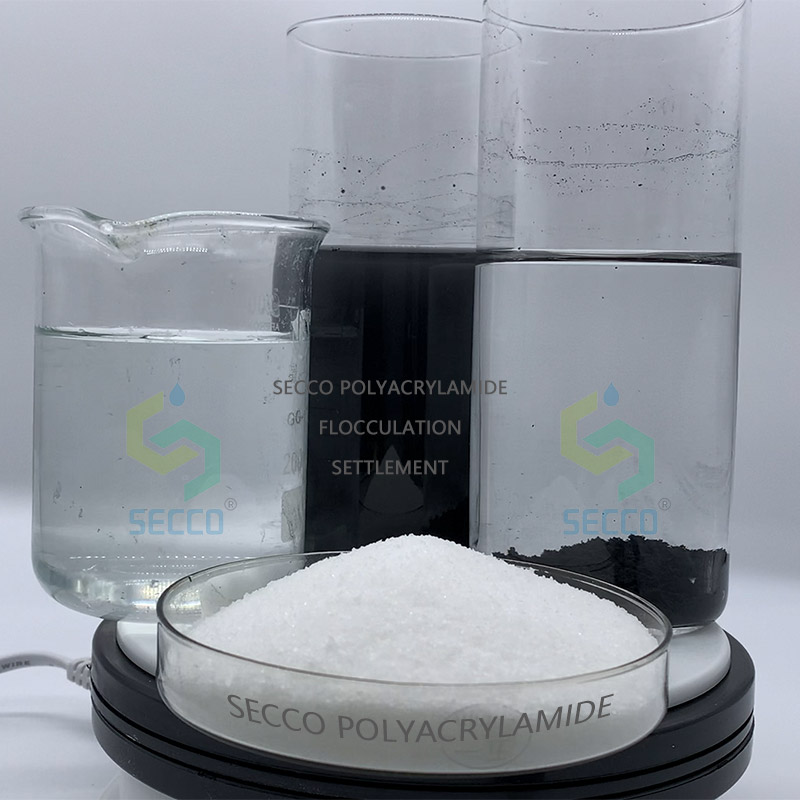
1. Common Problem: Why Does PAM Form "Fish Eyes"?
When PAM powder contacts water, its surface quickly swells and forms a gel layer, blocking further water penetration and resulting in semi‑transparent, gel‑like particles ("fish eyes"). These not only waste chemicals but also clog dosing pumps and pipelines, affecting system stability.
2. Core Techniques for Efficient Dissolution
2.1 Correct Feeding Method
With the mixer running, slowly and evenly sprinkle PAM powder onto the edge of the vortex. Never dump a large amount at once.
Secco Environmental recommendation: Pre‑wet the powder with a small amount of industrial alcohol or glycerin before adding it to water. This significantly reduces agglomeration.
2.2 Water Temperature and Quality
Optimal temperature: 35–60 °C (ordinary tap water is fine)
Avoid: Below 5 °C (extremely slow dissolution) or above 60 °C (thermal degradation, loss of viscosity)
Water quality: Avoid strong acids, strong bases, or high‑salinity water. Iron ions catalyze PAM degradation – use stainless steel, plastic, or FRP tanks.
2.3 Dissolution Time and Stirring Speed
Stirring speed: 60–120 rpm – excessive shear breaks molecular chains.
Typical dissolution time: 40–60 minutes (anionic types dissolve slightly faster than cationic types).
3. Advanced Methods to Boost Dissolution and Usage Efficiency
✅ Pre‑wetting (oil‑based dispersion)
Pre‑wetting PAM powder with white oil or a hydrocarbon liquid prevents surface gelation upon contact with water. Secco Environmental's on‑site tests show this method can reduce dissolution time by up to 80% , especially in high‑salinity or seawater‑based solutions.
✅ Dissolution aids
Adding a small amount of monoethanolamine (MEA) or urea to the dissolution water stretches PAM molecular chains, promoting faster dispersion.
✅ Specialized dissolution equipment
A jet‑type dissolution unit uses high‑pressure water shear to instantly disperse powder – ideal for large‑scale, continuous dosing systems.
4. Maximizing Usage Efficiency: Key Operational Parameters
| Parameter | Recommended Value | Notes |
|---|---|---|
| Make‑down concentration | 0.1% – 0.3% | Higher concentrations risk fish eyes; lower concentrations increase logistics cost |
| Mixing time after dosing | 10–30 seconds | Do not exceed 2 minutes – flocs may break |
| Solution storage life | Anionic PAM ≤ 7 days Cationic PAM ≤ 1 day | Prepare fresh whenever possible |
| Dosing sequence with PAC/PFS | Coagulant (PAC or PFS) first, then PAM | Improves settling speed and floc strength |
5. Secco Environmental Special Reminder: Recommendations by Sludge Type
Municipal sludge: Cationic PAM, ionic degree 30–50%
Coal washing wastewater: Anionic PAM, molecular weight >12 million
Papermill wastewater: Non‑ionic or low‑anionic PAM
Industrial mixed sludge: Use PAC or PFS as primary coagulant + PAM as flocculant aid
For a dosing proposal tailored to your specific water quality, please contact the technical department of Henan Secco Environmental Technology Co., Ltd. We offer free lab‑scale jar tests and on‑site guidance.
If you are interested in our products or have any questions, please fill in the form below. We will contact you immediately after receiving it. Thank you for your choice

Tel:+86 18703633076
Email: secco@hnsecco.com
WhatsApp:8618703633076
 Polish
 Russian
 French
 UAE
UAE farsi
farsi belarusian
 Danish
 German
 Filipino
 Finnish
 Sanskrit
 Korean
 Dutch
Dutch Haitian
 Kyrgyz
 galician
 Czech
Czech Latin
Latin Lao
Lao Romanian
 Lingala
 Luganda
 Luganda
 Kinyarwanda
 Lithuanian
 Malay
Malay Bur
Bur Marathi
 Macedonian
 Bengali
 Norwegian
 Nepali
 Portuguese
 Japanese
 Swedish
 Serbian
 Slovak
 Slovenian
 Somali
 Thai
Thai Shierqi
 Ukrainian
 Welsh
Welsh Greek
Greek Hungarian
 Hawaiian
 Hindi
Hindi Indonesian
 Italian
 Vietnamese