







Polyacrylamide (PAM) has long been known as a "versatile industry aid," playing an indispensable role in water treatment, oil extraction, papermaking, and many other fields. As one of the core products of Henan secco Environmental Protection Technology Co., Ltd., polyacrylamide has demonstrated strong technical strength and market value in conventional wastewater treatment thanks to its excellent flocculation, adhesion, thickening, and drag reduction properties. However, with continuous breakthroughs in materials science and engineering technology, the application boundaries of polyacrylamide are being redefined – it is gradually moving from a water treatment chemical to the forefront of road engineering construction, bringing a disruptive material revolution to highways, bridges, tunnels, and other infrastructure projects.
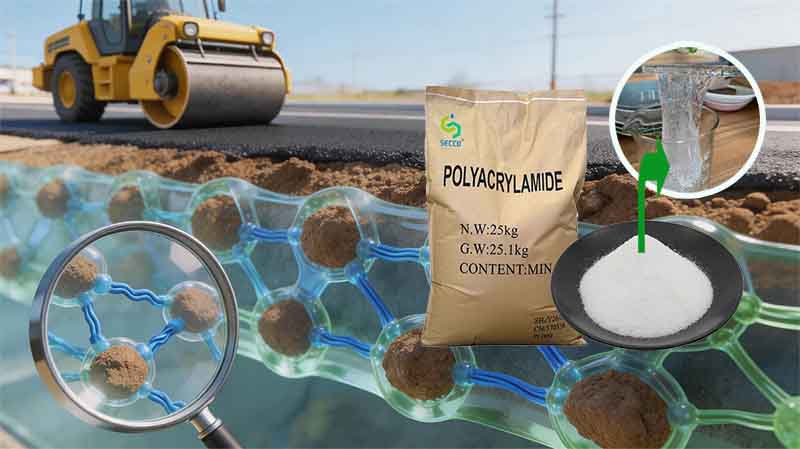
Polyacrylamide is a water-soluble linear high-molecular polymer formed by the polymerization of acrylamide monomers. The active groups in its molecular chains can adsorb and bridge soil particles, forming a three-dimensional network structure that significantly improves the mechanical properties and durability of soil. This article systematically reviews the novel applications of polyacrylamide in road construction, exploring how this environmentally friendly material is reshaping the underlying logic of modern roadbuilding.
The subgrade is the foundation of any road project, and its bearing capacity and water stability directly determine the service life of the road and traffic safety. In viaduct construction, bridge foundations typically need to be embedded in soil, and the bearing capacity of the soil is critical to the safety and longevity of the bridge. Traditional subgrade reinforcement methods mostly rely on inorganic materials such as cement and lime. However, these methods are not only energy-intensive and generate high carbon emissions but also often perform poorly when treating certain special soil types.
Polyacrylamide, as a new type of polymer soil stabilizer, is filling this technical gap. Studies have shown that after injecting PAM into the soil, its molecular chains can form a gel-like substance, helping soil particles bind tightly together, thereby enhancing the overall bearing capacity. This improvement method is particularly effective for soft soil foundations or uneven foundations. During construction, engineers only need to mix PAM with water and spray or inject it into the soil. This non-invasive construction method not only greatly reduces environmental impact but also significantly shortens construction time.
In saline soil areas, the tendency of soil to crack has long plagued highway construction. To address this problem, researchers used polyacrylamide as a water-soluble polymer to modify highway subgrade fillers based on saline soil, improving their compaction performance and crack resistance. Test results show that as the PAM mass fraction increases, both the liquid limit and plastic limit of saline soil samples increase significantly. Quantitative analysis of crack patterns reveals that the addition of PAM effectively reduces shrinkage strain and defects or pores in the saline soil.
In seasonally frozen soil regions, freeze-thaw cycles are particularly damaging to subgrades. A study published in 2024 found that combining polyacrylamide with straw fiber and biochar as a soil stabilizer (BPS) significantly improved the mechanical properties and freeze-thaw resistance of subgrades in cold regions. The 28-day unconfined compressive strength of BPS-treated soil reached 565.42 kPa, and the deformation modulus reached 17.24 MPa – 3.36 and 6.05 times that of untreated samples, respectively. The strength loss rate caused by freeze-thaw cycles was 49.3% lower than that of natural soil. Scanning electron microscopy revealed a triple stabilization mechanism of "filling-cementation-reinforcement," where PAM molecular chains form filamentous connections and gel film structures between soil particles, firmly binding biochar and fiber materials together.
With the continuous development of China's transportation infrastructure, tunnel shield construction, bridge drilled pile foundations, and other construction activities generate large amounts of waste slurry and shield muck. These wastes are characterized by high water content, fine particle size, and high clay content. Direct discharge would cause serious environmental pollution and waste of resources. How to efficiently dispose of these wastes and achieve resource utilization has become a critical challenge in road construction.
Polyacrylamide, with its efficient flocculation and dewatering properties, offers an ideal solution. A study on dewatering of waste slurry from bridge pile foundation construction in a certain area of Jiangxi Province showed that anionic PAM, cationic PAM, and nonionic PAM all exhibited the most significant dewatering effects at a concentration of 0.2% by mass. With only a small addition, the slurry flocculated and dewatered rapidly within 10 seconds, with water content significantly reduced by 29.5%, 24.3%, and 19.5%, respectively. Anionic PAM performed best, with supernatant turbidity dropping to 20 NTU after 2 hours. Fine particles effectively aggregated into larger flocs, and the D90 particle size increased from 15.10 μm to 25.50 μm, an increase of 68.9%.
In tunnel shield engineering, similar research has achieved breakthroughs. To address the difficulty of separating high-water-content, high-clay-content waste slurry from a slurry shield tunnel in the Jiangyin Second Cross-River Passage project, researchers conducted systematic tests using anionic polyacrylamide, polyaluminum chloride, and other flocculants. The results showed that the combination of organic and inorganic flocculants performed best for dewatering, achieving a 90-minute dewatering rate of 29.6% and reducing supernatant turbidity to 62.0 NTU. The study further revealed that the dewatering effect of the composite flocculant is mainly dominated by the adsorption-bridging action of anionic PAM long chains, providing a scientific basis for efficient mud-water separation and dewatering of shield muck.
Even more noteworthy is that the innovation of polyacrylamide in shield muck disposal goes far beyond "treatment" itself. The patent for "Green degradable mud flocculant and preparation method thereof" recently filed by China Railway No.4 Engineering Group Co., Ltd. combines polyacrylamide with photocatalytic degradation nanomaterials. Under light conditions, residual PAM can be degraded into harmless small molecules such as CO₂ and water, truly enabling the extraction of reusable subgrade filler from high-water-content waste muck and setting an example for the green circular economy in road construction.
In actual engineering, during the construction of the Shaanxi Meixian-Taibai Highway, PAM was added to purify tunnel water inflow, treating approximately 25,400 cubic meters of water per day. This successfully solved the problem of daily discharge and achieved the ecological promise of "no pollution during construction." This successful experience provides a replicable and scalable technical model for major transportation projects in ecologically sensitive areas.
In mountainous highway construction, ecological restoration and soil conservation on high and steep slopes have long been challenging. Traditional support methods such as wire mesh shotcreting can ensure short-term slope stability but suffer from poor greening effects and low ecological benefits. In seasonally frozen soil areas, intense freeze-thaw cycles make high and steep rocky slopes highly prone to landslides and collapses.
The application of polyacrylamide in ecological protection of high and steep slopes shows great technical potential. A study on ecological restoration of high and steep rocky slopes in seasonally frozen soil areas found that using polyacrylamide combined with carboxymethyl cellulose (CMC) as a soil improver significantly enhanced the soil's shear strength, water stability, freeze-thaw resistance, and erosion resistance. Scanning electron microscopy revealed that the gel film formed by polyacrylamide and CMC provides "bridging" and bonding between soil particles, thereby enhancing overall soil stability. The study determined the optimal PAM application rate to be 3%, at which soil structure was effectively improved without inhibiting vegetation growth. Further field application studies showed that PAM-improved soil could stably adhere to high and steep rocky slopes, with good vegetation growth that persisted through five months of freeze-thaw cycles and continued without manual maintenance after one year.
For soil erosion control on embankment slopes and cut slopes, PAM has also demonstrated excellent performance. A field rainfall study on highway cut slopes and landfill covers in the United States showed that applying anionic polyacrylamide reduced total soil loss by 40% to 54% while significantly promoting vegetation establishment and growth. The study noted that on very steep slopes – especially those with slope ratios of 2:1 to 3:1 – PAM application provides effective soil protection during the critical establishment period for vegetation, significantly reducing on-site damage and remediation costs, as well as mitigating the adverse effects of soil erosion on surrounding water bodies.
Haul roads in open-pit mining areas and temporary construction access roads are major sources of fugitive dust. This is especially true for mine haul roads carrying heavy vehicles – in high-temperature, dry environments, water evaporation from the road surface is extremely high, and vehicle disturbance is intense. Conventional water spraying for dust suppression is not only of limited effectiveness but also consumes enormous amounts of water. Statistics show that dust from haulage equipment accounts for the largest share of dust generation in open-pit mines, with over 80% of mine dust originating from road dust kicked up by moving vehicles.
Humectant-based dust suppressants with polyacrylamide as a key component offer a sustainable green solution. A study on haul roads in an open-pit coal mine showed that a humectant dust suppressant formulated with glycerin as moisturizer, sodium dodecylbenzenesulfonate as wetting agent, and polyacrylamide as coagulant formed a thin film on the road surface that provided both moisture retention and consolidation functions, effectively capturing and settling dust particles. Field industrial test data showed that total dust and respirable dust concentrations on both load-bearing and non-load-bearing sections sprayed with the suppressant were significantly lower than those on conventional water-sprayed sections, and both were below national regulatory limits. The average soil moisture content after suppressant application was more than twice that of conventional water-sprayed sections, and the effective dust suppression time per application reached 3 to 4 days. PAM played a core role in dust coagulation – its long polymer chains adsorb and aggregate fine dust particles into larger clusters – achieving significant dust suppression effects, making it highly suitable for dust control under dynamic working conditions such as mine roads.
In high-grade road projects such as viaducts and tunnels, concrete performance directly affects engineering quality and safety. The application of polyacrylamide as a concrete additive is expanding the performance boundaries of road construction. When PAM is added to concrete, its efficient thickening action increases concrete consistency and reduces water demand, thereby lowering concrete shrinkage. This not only improves the compressive and tensile strength of concrete but also significantly extends the service life of road infrastructure.
Polyacrylamide also effectively prevents excessively rapid water evaporation from concrete during construction. It forms a protective film on the concrete surface, slowing the evaporation process and preventing cracking caused by rapid moisture loss – a particularly valuable characteristic in hot, dry climates. At the same time, PAM improves the adhesion of concrete, reducing the risk of slippage during high-elevation concrete placement, thus providing new technical support for construction safety management.
In terms of improving the durability of cement-stabilized soil pavements, domestic researchers have also made important progress. To address the poor durability of conventional cement-stabilized soil, researchers added polyacrylamides with different water absorption properties to cement-stabilized sand and conducted unconfined compressive strength tests, dry-wet cycle tests, drying shrinkage tests, and microscopic analysis. The results showed that PAM addition not only effectively increased the strength of cement-stabilized soil but also improved its resistance to dry-wet cycle damage and enhanced its resistance to drying shrinkage cracking. Scanning electron microscopy confirmed that PAM formed an integrated "PAM – cement paste – soil particle" network structure within the cement-stabilized soil, providing a microstructural basis for improved macroscopic mechanical properties.
The application of polyacrylamide in road construction is undergoing a profound transformation from "auxiliary additive" to "core functional material." Looking ahead, with continuous advances in molecular structure design and composite material technology, specialty functional PAM materials will continue to emerge: salt-resistant hyperbranched anionic polyacrylamide for high-salinity soil environments, biodegradable PAM to completely solve the problem of potential microplastic residues from long-term application, and synergistic combinations of PAM with nanomaterials and microbial agents that will open entirely new directions for eco-friendly roadbuilding materials.
For the road construction sector, the value of polyacrylamide lies not only in improving engineering quality but also in providing a "green and sustainable" technical pathway. From subgrade stabilization to slurry purification, from slope protection to dust suppression, and concrete performance enhancement, PAM is transforming the relationship between infrastructure and the environment from confrontation to symbiosis. As a high-tech enterprise specializing in the R&D and production of polyacrylamide and other polymer flocculants, Henan Secco Environmental Protection Technology Co., Ltd. will continue to focus on the cutting-edge field of "environmental protection + infrastructure." With high-quality products and customized technical solutions, we are committed to helping China's road construction move toward a more efficient, safer, and greener future.
If you are interested in our products or have any questions, please fill in the form below. We will contact you immediately after receiving it. Thank you for your choice

Tel:+86 18703633076
Email: secco@hnsecco.com
WhatsApp:8618703633076
 Polish
 Russian
 French
 UAE
UAE farsi
farsi belarusian
 Danish
 German
 Filipino
 Finnish
 Sanskrit
 Korean
 Dutch
Dutch Haitian
 Kyrgyz
 galician
 Czech
Czech Latin
Latin Lao
Lao Romanian
 Lingala
 Luganda
 Luganda
 Kinyarwanda
 Lithuanian
 Malay
Malay Bur
Bur Marathi
 Macedonian
 Bengali
 Norwegian
 Nepali
 Portuguese
 Japanese
 Swedish
 Serbian
 Slovak
 Slovenian
 Somali
 Thai
Thai Shierqi
 Ukrainian
 Welsh
Welsh Greek
Greek Hungarian
 Hawaiian
 Hindi
Hindi Indonesian
 Italian
 Vietnamese