







In wastewater treatment and sludge dewatering processes, Polyacrylamide (PAM) plays a critical role as a flocculant. Its dissolution efficiency, flocculation performance, and compatibility with dewatering equipment directly determine treatment effectiveness and effluent quality. However, improper product selection or operation often leads to poor results.
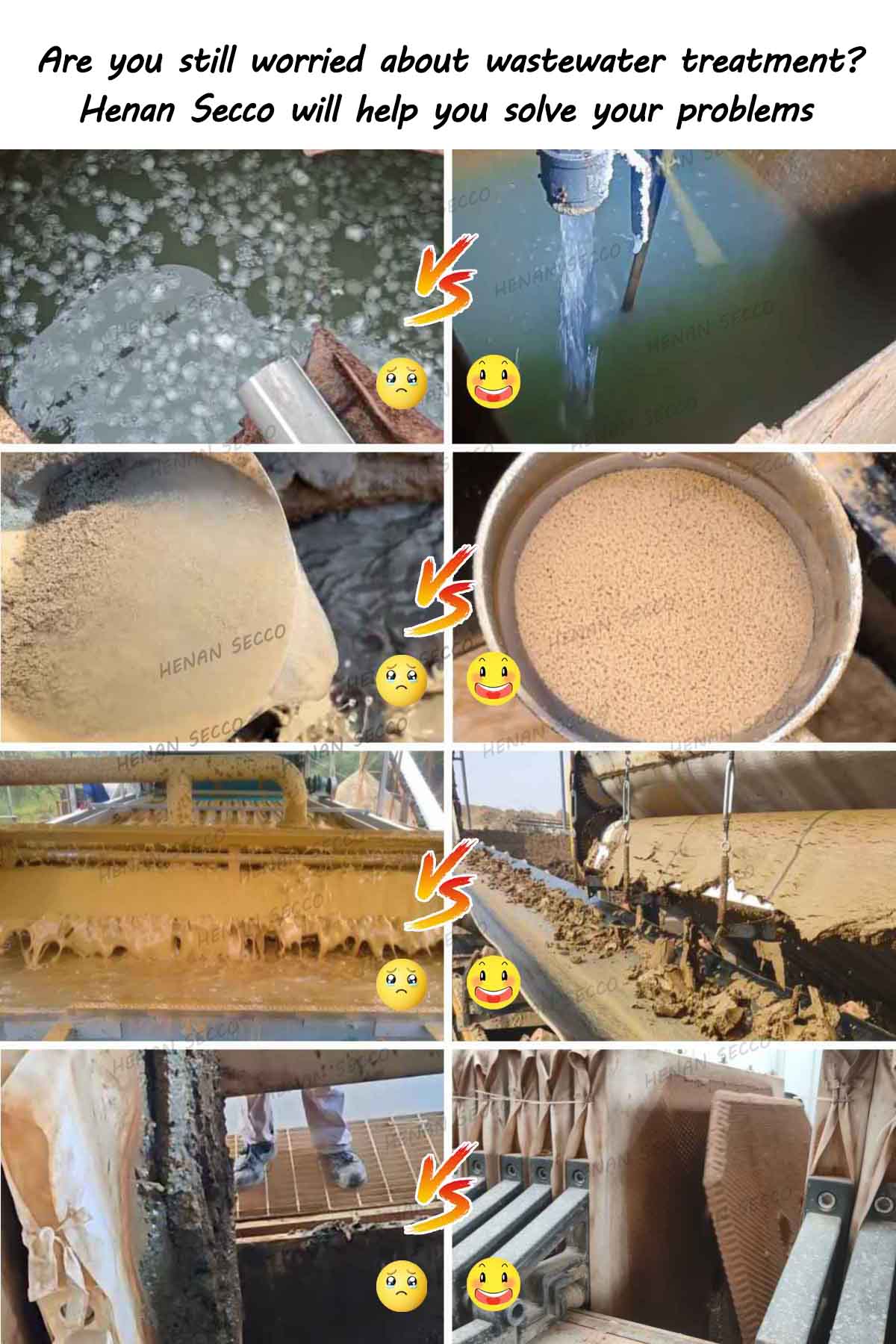
This article presents four real-world comparison cases, highlighting the huge differences between poor performance and correct performance, along with professional solutions from Henan Secco Environmental Technology Co., Ltd.
Case 1: PAM Mixing & Dissolution – Flocs vs. Uniform Solution
Poor Performance:
A manufacturer added PAM into a mixing tank but observed many insoluble, transparent “fish eyes” (PAM agglomerates). This not only wastes chemicals but also clogs pumps and filters, seriously affecting subsequent treatment.
Correct Performance (Secco Solution):
Using Secco’s high-purity anionic/cationic PAM, combined with standardized mixing and dosing, the polymer dissolves completely into a uniform, transparent solution – no lumps. Chemical utilization approaches 100%, laying a solid foundation for efficient flocculation.
Key technical point: PAM must be fully dissolved to maximize its bridging effect. Secco’s PAM features uniform molecular weight distribution, rapid dissolution, and effectively avoids “fish eyes”.
Case 2: Sand Washing Wastewater Flocculation & Sedimentation – Turbid vs. Crystal Clear
Poor Performance:
A sand washing plant used an ordinary PAM, resulting in small, slow-settling flocs. The supernatant remained turbid, making reuse or discharge impossible. Fine sand also escaped with overflow water.
Correct Performance (Secco Solution):
Secco’s customized high-molecular-weight anionic PAM for sand washing wastewater produces large, fast-settling flocs. After sedimentation, the supernatant is crystal clear, with suspended solids (SS) removal >95%. The clean water can be fully recycled back into production.
Image caption: Left – turbid, grey water; Right – crystal clear water.
Case 3: Belt Filter Press Sludge Dewatering – Wet, Diluted Sludge vs. Dry Cake
Poor Performance:
A wastewater treatment plant used inferior PAM before its belt filter press. The sludge flocs were loose, and after pressing the cake moisture content exceeded 85% – the sludge was still wet and runny, causing leakage during transport and high disposal costs.
Correct Performance (Secco Solution):
Secco’s high-performance cationic PAM produces dense, shear-resistant flocs. After pressing, the sludge cake moisture content drops to 65–75%, forming cohesive, non-free-water cakes. Discharge is smooth, significantly reducing transport and incineration/landfill costs.
Image caption: Left – wet, diluted sludge; Right – dry, firm cake.
Case 4: Filter Press Sludge Dewatering – Sticky, Wet Cake vs. Dry, Easy-to-Release Cake
Poor Performance:
A factory used regular PAM in its filter press. The sludge cake moisture content remained >80%, and the cake stuck heavily to the filter cloth. Manual scraping was frequent, and cloth life was very short.
Correct Performance (Secco Solution):
Secco’s special cationic PAM, tailored for organic sludge conditioning, reduces cake moisture content to below 60% after pressing. The cake is hard, easily detaches automatically from the filter cloth, and cloth cleaning intervals are extended by over three times.
Image caption: Left – sticky, dripping cake; Right – dry, cracked cake that falls off naturally.
Why Choose Henan Secco Environmental Technology Co., Ltd.?
Professional R&D & Manufacturing: Over 10 years of focus on polyacrylamide (PAM), polyaluminum chloride (PAC), and other water treatment chemicals. Product range includes anionic, cationic, non-ionic, and amphoteric series.
Customized formula for each client: Precise product selection based on your wastewater characteristics and equipment (belt press, filter press, centrifuge, etc.). Free lab-scale jar tests and on-site pilot trials.
Performance guarantee: No dissolution lumps, fast flocculation, dry sludge cake, crystal clear effluent – or your money back.
Stable supply: Annual production capacity of tens of thousands of tons, strictly meeting GB/T 17514-2017 or equivalent international standards.
Get Your Custom Dewatering Solution Today
If you are facing issues such as high sludge cake moisture, turbid effluent, or chemical waste, contact us for free samples and lab testing. Henan Secco – turning every drop of muddy water into a resource.
If you are interested in our products or have any questions, please fill in the form below. We will contact you immediately after receiving it. Thank you for your choice

Tel:+86 18703633076
Email: secco@hnsecco.com
WhatsApp:8618703633076
 Polish
 Russian
 French
 UAE
UAE farsi
farsi belarusian
 Danish
 German
 Filipino
 Finnish
 Sanskrit
 Korean
 Dutch
Dutch Haitian
 Kyrgyz
 galician
 Czech
Czech Latin
Latin Lao
Lao Romanian
 Lingala
 Luganda
 Luganda
 Kinyarwanda
 Lithuanian
 Malay
Malay Bur
Bur Marathi
 Macedonian
 Bengali
 Norwegian
 Nepali
 Portuguese
 Japanese
 Swedish
 Serbian
 Slovak
 Slovenian
 Somali
 Thai
Thai Shierqi
 Ukrainian
 Welsh
Welsh Greek
Greek Hungarian
 Hawaiian
 Hindi
Hindi Indonesian
 Italian
 Vietnamese