







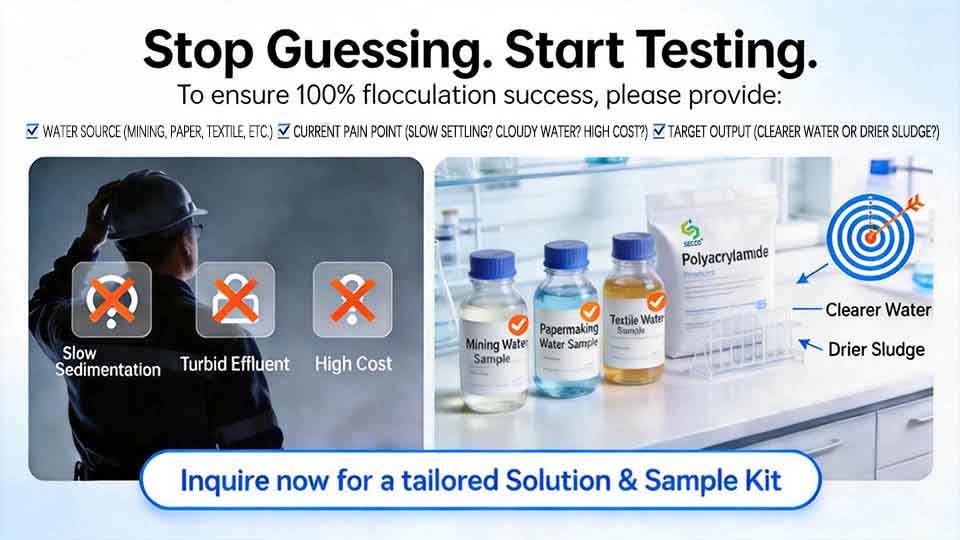
There is no one‑size‑fits‑all answer in wastewater treatment, but there is a more efficient path to results. Stop taking detours through guesswork. Start finding the truth through testing. Contact Henan Secco Environmental Technology Co., Ltd. today to get your customized flocculation solution.
Click to view →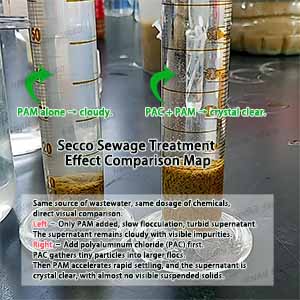
In wastewater treatment, flocculation and sedimentation are among the most common and critical steps. However, many users initially tend to use only one type of flocculant — most often polyacrylamide (PAM). But does using PAM alone truly achieve ideal purification results?
Click to view →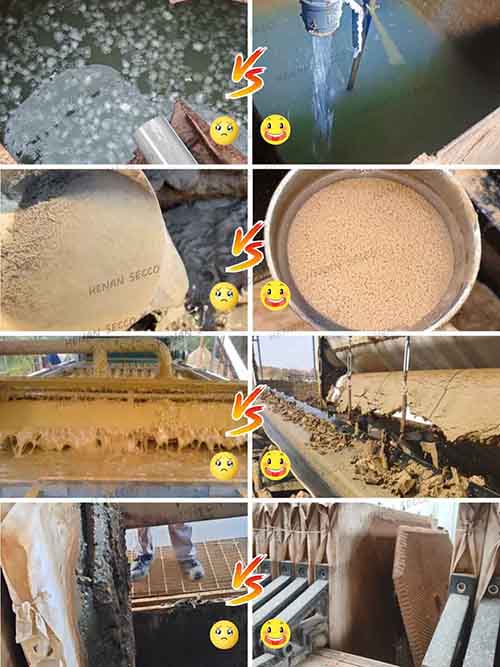
This article presents four real-world comparison cases, highlighting the huge differences between poor performance and correct performance, along with professional solutions from Henan Secco Environmental Technology Co., Ltd.
Click to view →
Polyacrylamide (PAM) has long been known as a "versatile industry aid," playing an indispensable role in water treatment, oil extraction, papermaking, and many other fields. As one of the core products of Henan secco Environmental Protection Technology Co., Ltd., polyacrylamide has demonstrated strong technical strength and market value in conventional wastewater treatment thanks to its excellent flocculation, adhesion, thickening, and drag reduction properties.
Click to view →
When PAM powder contacts water, its surface quickly swells and forms a gel layer, blocking further water penetration and resulting in semi‑transparent, gel‑like particles ("fish eyes"). These not only waste chemicals but also clog dosing pumps and pipelines, affecting system stability.
Click to view →
When dealing with wastewater, polyacrylamide (PAM) and polyaluminium chloride (PAC) are commonly used as coagulants and flocculants to remove suspended solids, color and other pollutants from the wastewater. The following are the basic operation steps for using these two chemicals.
Click to view →
During the mining process, a large amount of wastewater containing heavy metals and suspended solids is produced, which is extremely difficult to treat. However,Secco polyacrylamide (PAM) has become an efficient treatment agent in this field.
Click to view →
In the field of water treatment, terminology matters. A common point of confusion among professionals and plant operators is whether Poly Aluminium Chloride (PAC) functions as a coagulant or a flocculant.
Click to view →
Anionic Polyacrylamide (APAM) has proven to be a highly effective dust suppressant due to its unique **long-chain molecular structure** and exceptional **hydration properties**. It achieves efficient dust control through the following core mechanisms:
Click to view →
Fish cannery wastewater is a typical high-concentration, high-turbidity, and poorly biodegradable organic effluent from food processing. Traditional physical sedimentation methods are inefficient, while direct biological treatment is overloaded. As a high-performance polymeric flocculant, polyacrylamide plays the central role of a "scavenger" and "accelerator" in this process.
Click to view →If you are interested in our products or have any questions, please fill in the form below. We will contact you immediately after receiving it. Thank you for your choice

Tel:+86 18703633076
Email: secco@hnsecco.com
WhatsApp:8618703633076
 Polish
 Russian
 French
 UAE
UAE farsi
farsi belarusian
 Danish
 German
 Filipino
 Finnish
 Sanskrit
 Korean
 Dutch
Dutch Haitian
 Kyrgyz
 galician
 Czech
Czech Latin
Latin Lao
Lao Romanian
 Lingala
 Luganda
 Luganda
 Kinyarwanda
 Lithuanian
 Malay
Malay Bur
Bur Marathi
 Macedonian
 Bengali
 Norwegian
 Nepali
 Portuguese
 Japanese
 Swedish
 Serbian
 Slovak
 Slovenian
 Somali
 Thai
Thai Shierqi
 Ukrainian
 Welsh
Welsh Greek
Greek Hungarian
 Hawaiian
 Hindi
Hindi Indonesian
 Italian
 Vietnamese